Search This Blog

Showing posts with label MIT 2021. Show all posts

Thursday, 28 October 2021

MIT Hui Wananga 2021

Talofa lava!  Can't believe it, it finally arrived .. MIT Hui Wananga 2021! 

From applying for MIT to presenting in front of a live online audience .. nerve-racking!  Throughout the year, the whole inquiry process was thought-provoking & enriching especially as a Junior teacher. Unpacking the challenges we face in our classroom to the multiple solutions sought after, that best fits our learners. 

Even prior to presenting our pre-recorded video, upon reflection there were few key elements that I missed.  In saying that, long term I'm looking forward to post-MIT how to grow our emerging bilingual students to succeed in all areas of learning.  It won't be an easy feat but will try! 

  "E sui faiga ae tumau fa'avae" translates to "The form changes, but the underlying principles remain".

During the Hui, this Samoan proverb protrudes, as we live an evolving world given our perspectives, approaches & PCK alters still the foundation remains.  From the talanoa from Sir Pat Snedden, Dr Rebecca Jesson's & team, how do we give skills when they learn how to apply tomorrow and when we're not there.

Faafetai, faafetai, faafetai lava to Dorothy & Matthew through their mentorship & leadership & patience, through our MIT journey.  Jenny Oxley & team for behind the scenes, administering this to make it happen (& Uncle Bill).  

To our MIT cohort 2021 - "Never doubt that a small group of thoughtful committed people can change the world.  Indeed, it is the only thing that ever has" quote by Margaret Mead.  History-makers!


Saturday, 4 September 2021

Online Hui #3

Due to level 4 lockdown in Auckland, it was good to see everyone online after our MIT Cook Island Trip.  

We reflected how everyone is overall, how we were managing during lockdown.

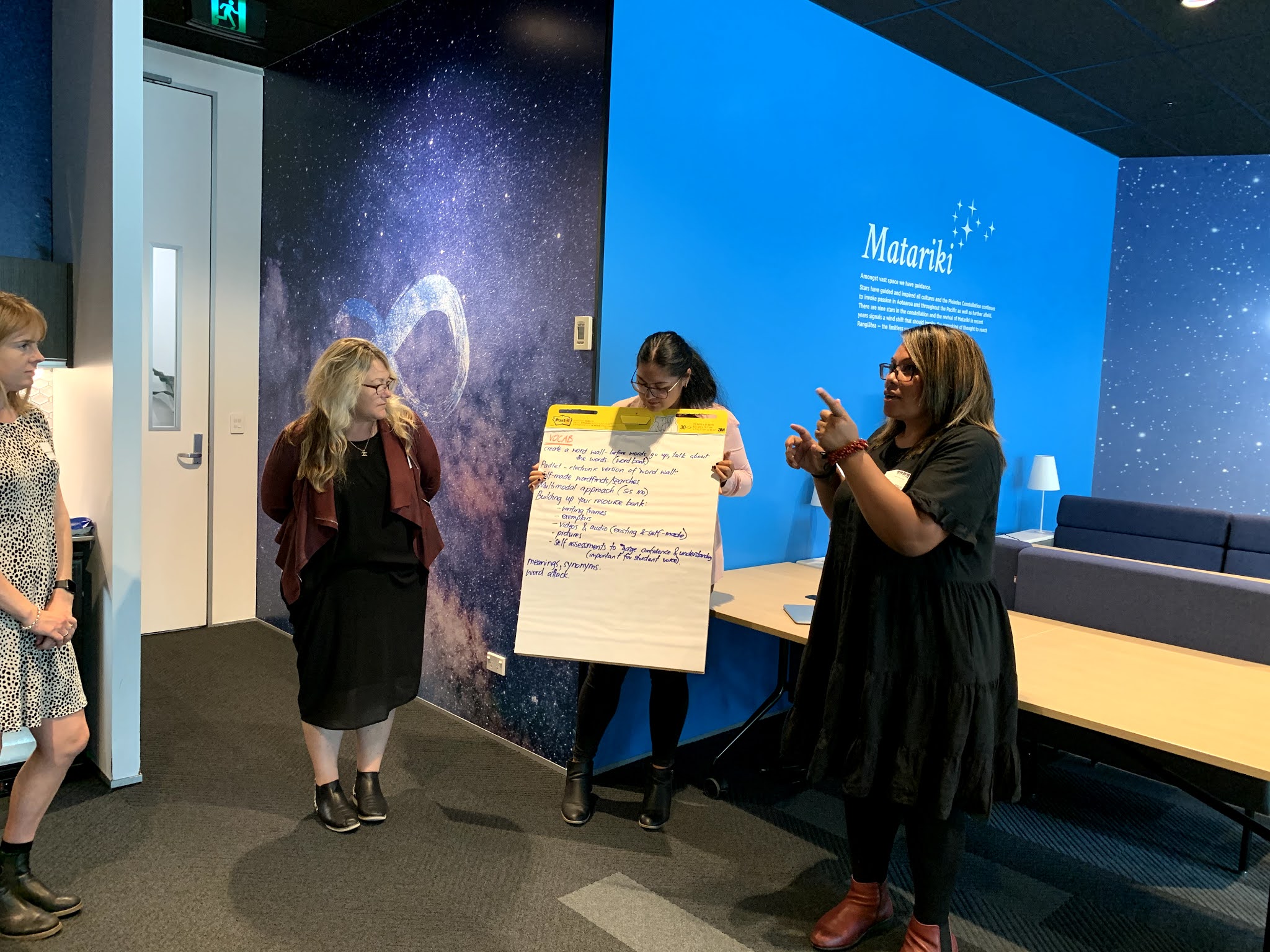
An online activity was working in pairs and retelling our peer what our project is and the project outcome.  We had to set up our own google meets.  Then feedback to the team what your peer is working on.  It was a good exercise as both parties had to listen and interpret to the team what their project is.  

My Project - "Unbox a box" - Supporting a large group of our Year 5 emerging bilingual students who are reading 2+ years below their reading age

What was working?  From the last KPMG and our Cook Island trip, I just started to lay down the process with our reading groups.  Setting up the norms.  Started to look and use Pacific dictionaries for maths as well as literacy. Working on my site.

What wasn’t working?  A lot more challenging not being able to have face to face connect with our learners during lockdown.  Unable to regularly meet with the group to have our learners read the text together.  Most of our target learners are not online engaging through various reasons eg family responsibilities etc.  

What can you do/have you done in Lockdown?  During our remote learning we've been working as a team to ensure our learners are accessing work.  I've been able to touch base and read with a couple of students, however haven't been able to have the same group to follow up task on building vocabulary.  I'm working on building vocabulary work for the selected reading on that day.   Checking that our learners well-being is paramount.

Has lockdown affected your project? Most definitely as with our emerging bilingual students they need more teacher support to guide them with reading and being able to ask questions readily when they're unable to understand.  A good problem to have.

Tuesday, 24 August 2021

Rarotonga

Kia orana katoatoa i teia ra manea. Kia Orana, e kia Manuia! 

 A snap shot of our trip to the Cook Islands. 

 Just a huge thank you to Principal Mark Harris from Apii Te Uki Ou and the team who hosted our visitors to explore and experience the Cook Islands - Meitaki Maata! 

Especially huge appreciation to Manaiakalani & CEO Jenny Oxley. 

 Meitaki Maata! Kia Manuia! Ka Kite!

Monday, 23 August 2021

Raro - PechaKucha Presentation

The main part of our trip was to present to a group of professional teachers in the Cook Islands.  A form we used is call 'PechaKucha'. 

 What? "Pikachu??" (Pokemon species .. familiar within my class) 

Did you know that PechaKucha is a form of storytelling, designed to show 20 slides - allows the speaker to fit 20 seconds to speak.  It started in Tokyo in 2003, designed by architects, Astrid Klein and Mark Dytham.   

To prepare for this presentation, we were given a template to help our slides flow in order and sequenced with our narrative.  No videos or giphy were allowed to be used.   However I like this format as it keeps the main thing the main thing.  It was difficult to make changes once you've submitted your slides - however it kept the audience's attention.

I was given positive feedback that evening, I was the only one who started with a Cook Island Mihi form, good use of expression and intonation in my voice.   I froze when I got up on the podium - we were to memorise our speech (eek!).  But overall a great experience especially prepping for our October Hui.


Rarotonga - Cultural responsiveness practice

From this trip, it took me back to a workshop we attended with our guest speaker Dr Rae Siilata. She uses the Va'atele framework (or double hulled canoe) as a metaphor for our leaners experiences navigating through the NZ school system. 

 As professionals, from a cultural responsiveness lense, was to be aware of our own and our learners cultural identity and views. Throughout our trip, observing the learners using storytelling, humour, arts, drama, singing, onhands learning (gardening), mindful of sustainability & environment. 

 Within the MIT cohort, our teachers practice cultural responsiveness with ease - key things that were reinforced on our trip, relationships, learners prior knowledge, learning contextual, space, each learner has a story to share and collaboration.


Monday, 7 June 2021

KPMG Session #2

Walking alongside the Viaduct Dock towards KPMG, always makes me feel like I'm getting ready to get 'super-charged'.  Meeting up with my fellow MITians to hear and share how we're progressing.  

From our last KPMG session, I struggled to have a clear process in my head about how I wanted to tackle my challenge which was "Supporting a large group of our Year 5 emerging bilingual students who are reading 2+ years below their reading age". 

So many great ideas were cast during the Teacher PD last day of Term 1.  However, a few things stood out for me.

What's working?
The continuous korero with senior colleagues and peers to incorporate ideas to develop our learner's comprehension.  Using Robyn Anderson's PD 'Getting the talking in reading', applying the modal verb questioning within our class discussions.  Using lexical chunking with our inquiry and writing.  

What's not? 
As it's taken a while to have a logical picture in my head, I've just started to apply a few of the above things to help me in my class.  Time constraints as well as my brain operating like 'Dial-up' internet.

What's next? 
Being able to start a framework to build their content knowledge and language acquisition, by using specific language focus, looking at the input (static images, signage, moving images, realia, experiences with authentic experience). with output through oral language.  (van Hees, J 2007).

 "Practice makes perfect" is my korero for my teaching & class.  As I've got a clearer image in my head of how this will work, I'm looking forward to the process. 

Wednesday, 5 May 2021

Manaiakalani Teacher Professional Development Day

On the last day of term 1, the Manaiakalani cluster held their Ko te Kāhui Ako o Manaiakalani - Teacher Only Day. 

We had an appetizing smorgasbord of amazing workshops and pedagogies for us to choose from.  Our main speaker Dr Rae Si'ilata shared about Translanguaging and Literacies with our emerging bilingual learners.

She shared her experiences as a learner and a professional with challenges and ideas of how we can better engage our learners.  Using the Va'atele Model will guide us on how to better connect and have our learners succeed.

A couple of things struck a chord with me:
1. Finding more texts as windows than mirrors. 
2. Getting the 'talk' going in reading.  (Wonderful workshop from Robyn & Chantel Panmure Bridge School) .  
3.  The value of sharing our own stories, languages, and experiences that connect with the story or content in the book.
4.   Provide students with the opportunity to create using new media - collaborate, making choices in learning, creating and sharing.

Principles to keep in mind when planning:
* Prior knowledge plays an important role
* Comprehension depends on metacognition
* Reading and writing are integrally related
* Learning increases when students collaborate

It's helping me chip at my MIT challenge which is 'Supporting a high group of our Year 5 emerging bilingual students who are reading 2+ years below their reading age'.

By using Robyn Shearer's framework in developing more talk within the classroom.  For learners to work collaboratively together to create more 'mirror' texts that are 'authentic text.  Still thinking through my process .. lol!

Monday, 5 April 2021

Collecting Data - MIT Term 1

"Everyone will have an opinion about what is going on for learners – what we need is to make sure that we have rich sources of evidence to back up our opinions." – Timperly, Kaser & Halbert (2014, p.7)

Gathering, analysis, and sharing of achievement and pastoral data provide the evidence that informs effective inquiries.


Prior to our Kuatonunu Hui, the data I was able to collect was 'running record 2020'.  The graph (left) shows the reading age our learners achieved for term 4 2020.  

The red line shows where they should be at.  There is a gap between where they're at and where they should be.


This graph (right) shows the levels that our learners have achieved for term 4 2020.  However, the red line tells us where they should be by the end of 2021.  

The gap is widening for our lower readers.  Looking through their running records, their decoding is above 96% however the comprehension questions they struggle with, especially inferencing and application questions.  

If we had to break it even further, analyzing their PAT results:

This graph (left) shows the results of our lower quartile of my reading groups,  The PAT reading test asks 3 types of questions (with 6 text types) that is 'retrieval, local inferencing and global inferencing.  

From the graph, we can see instantly that over 50% of our students passed 2 retrieval questions.  Where 1 local and global questions, over 50% have passed this question.  We can also see that 4 questions (3 local and 1 global question) that no one passed it.

  
This graph (right) displays the results from our Year 4 readers.  We can see that 2 out of 3 retrieval questions were answered over 50%.  The first question was asked, "How long do you soak the peanuts for?"  It was a procedural text.  Still uncertain why 0% of readers got this answer incorrect.  However, only 2 questions were answered correctly by over 50% of the students.  

From this, I am able to see where my class is struggling with the skill of inferring with multiple texts such as narrative, procedural, report, explanation, recount and poem. reports,  inferencing questions (local & global inferencing).  

Where to now ... Will definitely incorporate more different text types in our reading aloud, shared reading and reading groups.  

KPMG Session #1

Prior to our first session at KPMG, I was mulling over our Kuaotunu Hui where my initial challenge is "Our Year 5 emerging bilinguals struggled with reading."  

Immediately after this Hui, Auckland was in Covid-19 level 3 lockdown.  Slowly returning back to level 1 on 12th March.  We nervously were preparing for our Year 5 & 6's annual camp.

With the interruptions we've had, I wasn't able to get a student/whanau voice for my challenge.  However, I was able to speak with a couple of colleagues who gave me insight that may have clouded my focus ... Eeek!!

After today's session, this is the 7th version of my challenge "Supporting a high proportion of our Year 5 emerging bilingual students, who are reading 2+ years below their reading age."

One of our founding MITians Ria Tuala's proposal was 'creating online resources to raise the literacy of Pasifika ESOL students'.  From my crazy 8's, my colleagues indicated to create resources, something similar MITian Amber Wing's product is 'Story-telling' using this resource to build a pro-type. 

The first part of our session was the 3 W's for our project.

What's working?  Still working on my statement and focus.  Support from my team members and other peers.  Looking at research for ESOL and digital.  Reading over previous MITian's project who have similar challenges.

What's not - barriers/road bumps: The majority of my class participate in the 'Agility With Sound' programme that runs in the morning space - doesn't allow me to spend much time with them.  Since our last Hui, we've had Covid-19 lockdown, which has pushed our events (Year 5&6 camp and Fiafia event) out including our testing.  Our class has slowly transitioned back to normal. 

What opportunities do you sense? Continue to interview/consult with external agencies as Mangere Refugee Centre, Marilyn Carroll, Dr Jannie van Hees (Language Minds), Dr Rae Si'liata (Va'atele Framework).  Collecting data.  

During this first session, I was unable to produce a draft prototype as I was still unclear about my challenge.  However, it was insightful listening to my other peers presents their prototype product.  Especially feedback from KPMG representative Justine Todd.   

Wednesday, 3 March 2021

MIT 2021 - Discovery


Design Thinking Process
The first part of the 'Design Thinking process' is 'discovery'.  

Picture this - sitting in a school hall filled with local parents, murmuring "Why am I here?".  Moderating the meeting is BOT Chairman Oxley (Jenny) alongside Real Estate Burt (Dorothy) to discuss the challenges faced at fictitious Kuaotunu Area School.

Each MIT 2021 member was given a character from the local community parents to act out (e.g a professor, plumber, celebrity artist etc .. ). 

As the BOT Chairman presented each issue to the local body, there was a stirring of tension from disgruntled parents.  As it unfolds each issue was from each MIT member.  

Getting involved in the role-play allows you to wear someone else's shoes.  Having a different lens, being intentional when listening.  It was quite confronting when asking for honest answers. 

This allows us to look at things with a broad-minded aspect.  For us to return back to our initial challenge, review and reconsider.  

Friday, 26 February 2021

MIT Kuaotunu Hui 2021

 “If I have seen further it is by standing on the shoulders of giants” Sir Isaac Newton

This year, I am truly humbled and honoured to be a part of the Manaiakalani Innovative Teachers (MIT) 2021 cohort. 

During this weekend, all seven of the MIT 2021 cohort met at Kuaotunu.  Lead by a creative power duo Dorothy and Matt who facilitated and steered us to use multiple lenses for our challenge. 
By using the 'Design thinking process' we were able to unpack, re-examine our initial challenge and allow it to be translucent.

This was my first time to Coromandel - to share this Hui with a group of like-minded professionals, this was a wonderful platform to allow us to unravel uncertainties by discussion and collaboration.

Throughout the weekend, we had Jenny Oxley (CEO) mastering her acting skills with her Master Chef 'Bill' to ensure we were fed throughout the day.  

Dorothy started the retreat with the above quote.  This resonated with me,  as I thought about many other MIT alumnus who has gone before us, this would be my pathway to better my craft of teaching & digital practice for our 21st Century online lifetime learners.


MIT 2021 - Ideation

The final step of the 'Design Thinking process' is ideation. 

By using the Crazy 8's method,  we were given a set time to sketch ideas or possible solution for our dilemma.

The goal is to push from our first idea, to produce a wide range of solutions for our challenge.

 By using the stickers, we then anonymously voted which idea suited with our MIT colleague's proposal.  

We were able to place more than one sticker on their proposed ideas.  We then used a flashier sticker to choose the best idea.  

It was interesting to see which preferred solution my MITians preferred.  Only one sticker for my preferred solution 'Pod-cast'.    The rest supported the idea of creating resources/books for our emerging bilingual learners.  


MIT Moonshot

"To improve is to change; to be perfect is to change often." 

                                                                      Winston Churchill 


From my first interview applying for MIT 2021 up to now,  my challenge focus continues to change as it grows clearer.  

Step 1: Identify the challenge impacting achievement that I want to focus on in 2021 through the MIT design thinking process? 

My challenge with teaching Year 4's & 5's, steamed from my observations as well as their results/data.  Our ESOL (English for speakers of other languages) or emerging bilingual learners, found it difficult to decode or connect with allocated text independently. 

 This is my initial moonshot challenge: 

MIT 2021 - Who


The fourth part of the 'Design Thinking process' is 'Who'.

From refining our challenge clearer, our next step was to think and write down WHO would be able to make this all happen? Who are my go to? Who are experts in this field? Who are potential stake-holders? Who can make this all happen?

First I wrote in black pen, my immediate tier of contacts that would be able to help me.  Second I wrote in 'green' felt, outside the first tier who would be the next group of experts/professionals to allow this to come fruition?

Lastly the 'Who' written in orange was if I had to dream big, who would be the potential influencers and financial stakeholders who could make this universal?


MIT 2021 - Interpretation


The third stage of 'Design Thinking process' is 'interpretation'. 

From the last 2 phases 'discovery & empathy' we looked at how to analyze and dissect the problem.  Interpretation allows us to create opportunities for action in our plan.  

By using "How Might We ... turn our problem into an opportunity?" 

Interpretation transforms our challenges into meaningful insights. Finding meaning in our inspiration is how you create actionable opportunities for design. It includes storytelling, as well as sorting and condensing thoughts until finding a point of view and clear direction.

We were given our posters to update and present our tweaked challenge statement blu-tacked them on the wall.  

We were given time to read over each poster and provide 'HMW' post-it note for each one moonshot proposal.  

The feedback given by our MIT peers was valuable.  There were a few that I never thought of, but the rest I've had ideas about using it.  Wonderful session!


Moonshot 5 Whys?

After our moonshot proposal, our next step was to be paired up to ask "5 Whys" to unpack the crux/heart of the challenge.
I was paired up with Janine Bava from Awapuni School (Gisborne) to ask the 5 Whys to her challenge. Her moonshot slide included her "Whys", where I found it difficult to ask questions, as the slides had answered most of my questions.  But it was good to korero with Janine to see her 'thinking process' strategy, that I have now started to use 5 Why's.  

While Rebecca Henderson from St Francis (Christchurch) asked me "5 Why" questions to help me unpack my problem.  I found the process quite thought-provoking, however, it helped me think what was the 'root' problem, instead of 'surface' challenges.

Below is 2 slides (Thanks to Dorothy) that show the questioning and our answers 


The 5 Whys method is part of the Toyota Production System. Developed by Sakichi Toyoda, a Japanese inventor and industrialist, the technique became an integral part of the Lean philosophy.  “The basis of Toyota’s scientific approach is to ask why five times whenever we find a problem … By repeating why five times, the nature of the problem as well as its solution becomes clear.“ Taiichi Ohno 


MIT 2021 - Empathy


The second part of the 'Design thinking process' is 'empathy'.  

During this part, I teamed up with my 5 WHYs companion, Rebecca. 

From our discovery phase, we continued to use role-play to reenact a similar case scenario that caused our particular MIT projects. 

It gave us an opportunity to share briefly about our learners and their struggles and was able to build a sense of empathy for our learners.   and a deeper understanding of the range of different factors impacting our students and whanau we are seeking to address.

Role Play A: Context: a Year 5 student reading level 3.  He is unable to decode the text, even when the teacher 

Role Play B: Context: A math's lesson in class - a Year 7 & 8 students is trying his best to figure out what to do with a maths problem. He shows increasing frustration - he is not able to understand the problem or how to figure out an answer. 

In Design Thinking, empathy is, as explained in IDEO’s Human-Centred Design Toolkit, a “deep understanding of the problems and realities of the people you are designing for”. It involves learning about the difficulties people face, as well as uncovering their latent needs and desires in order to explain their behaviours. To do so, we need to have an understanding of the people’s environment, as well as their roles in and interactions with their environment.

Here is my 'empathize' poster of the learner.  My proposal challenge had changed from the initial start.