Search This Blog

Showing posts with label 2021. Show all posts

Thursday, 30 September 2021

Hui Fono Regional Workshop: Vā

During the holidays, I attended an online workshop facilitated by ACE  titled "Vā".  

This workshop was presented by Aiono Manu Faaea, who looked at the concept of vā (relationship / relational space).  She described 'Va Tapuia - sacred spaces' as follows:

  1. Separate by things (eg: va i moana, va i maunga, va i vao) 
  2. Space between people 
  3. Hostile space.

It was confronting to hear similar stories to my own experiences of how our Pasifika people have had to navigate without cultural awareness.  

In education, our Pasifika document 'Tapasa' it highlights 'Le va' (the space in between) in relationship and relatedness.

So how does this relate to my teaching practice?  The following questions from the Tapasa document stood out for me: 

  • What is my approach for encouraging Pacific learners to share their understanding of the va and its significance in social environments and/or spiritual settings?
  • How do I create space for my learners to ensure balanced reciprocity of giving and taking?
  • In what ways do I protect and preserve sacred space for Pacific learners in my school environment?

“There is a Samoan saying, ‘O le ala I le pule, o le tautua – the pathway to leadership is through service’.  

I'm currently part of MIT cohort investigating "How do I support a large group of our Year 5 Emerging bilingual students who are reading 2+ years below their reading age?"   

From this I'm able to think more clearer how can allow my learners to share their understanding, create a space for our learners to ensure balanced reciprocity of giving and taking.  As well as protect and preserve.  

My next steps is how do i bring familiarity/ traditional customs for our Emerging bilingual students to 'translanguage' with in building their reading?  Still thinking ...    

Wednesday, 25 August 2021

ToolKits Online - Minecraft for Beginners

 I was quite keen to learn more about Minecraft.  Both male and female students have a growing interest in learning about this platform.  

Louise has given a couple of where to begin when starting out on Minecraft.  Redesigning homes for our learners where is no restriction for our learners to use.  

Minecraft Education Edition - we will need permission from our tech person.  It is free of cost with our learners using our gmail to sign it.  

Foxcraft is a recommended YouTuber for Minecraft.  Check with our tech to download Minecraft on our MacBook Air.  Will definitely have a try soon!  Thanks Louise


Tuesday, 24 August 2021

Toolkits Online - Independent Learning - Contracts, Challenges and Stations

Key things to help me organise for independent learning:  

1. Established routines & rules:  Each child is an expert.  Each child needs to learn and practice.  3 before me.  Try and solve the problem without seeing me.

Contracts:  - the student plans and works out what their timetables look like.

- Compulsory tasks that student has to complete.  Deliberate planning to what needs to be done.  

Support students that struggle more - activities to buddy up.  Check-in with target groups regularly.- Meet with those students, go through all the tasks on the task.  I will check that they know what it's about.  The only group that is supported to timetable their work.  The planning is required prior to starting the contract. 

Monitoring:  Uses a data sheet.  Target inquiry group and follow through with learners who are reluctant to finish work.  Uses Hapara to filter websites that are appropriate to the task.   

Success criteria are established at the beginning of the class to ensure the learner will complete each task to a high quality.  The tasks have already been done.  Otherwise, the student can repeat the task again.

Each learner has the same contract.  Check that supports are there for struggling learners.  


Sunday, 20 June 2021

T-Shaped literacy skills for Junior

 We've got Dr Rebecca Jesson (from Fisher Woolfe).

To learn about the world, words - you need to read widely.  Wide reading is also one of the key ways that learners develop word knowledge and world knowledge.  This includes multimodal texts.

Practice makes perfect, more practise getting better.


Wide reading (5+ day exposure to text)

- Reading to students: word knowledge, world knowledge

- Shared reading:  Big Book reading, re-read it with a different focus on each day.  Word knowledge, world knowledge, practice

- Buddy reading: Practice, endurance, resilience

- Independent reading: (eg publishing, book box reading, reading the room, poetry, books, learning centres etc .. )


How can we read deepen:

- text sets that complement, contradict that, building understanding over time.  4 different types of text related to the topic.

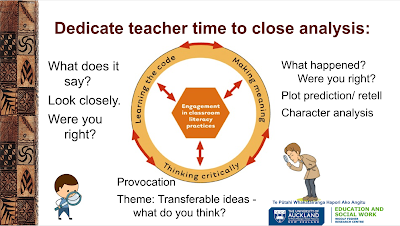
Part 1: Ways of getting the themes from the books:

1.  Look for the big idea (abstract)

2. Look for what the main character learns

3. Look for change over time in the book.


Who is the main character?

a) Who changes most?  b) Who learns most?  c)Sidekicks - what are their roles?  d)What is the relationship? 

Transferring our knowledge to new experiences: let's think about how the character uses what they learn: *how a lesson is taught and applied. *The in-joke between characters who shared an experience. *What characters know about.

Likeable and unlikeable characters How does a text create characters that we like? don't like it? 

Synthesis treats them like a set.  Higher-order thinking skills require people to bring knowledge from different 

=> Next 'Stuck for a provocation? GO to NZ


Come to the text, thinking - "thought" & cause "provoked" them.  It's about ideas & critical thinking.

When introducing the text:  it's about the 'big idea'.

=> Go back to your modelling book.   Word walls/Word cards/image match etc can't need

=> Did I do this?

1. Look closely at selected passages

2. Carefully choose the important bits to 'get'

3. Analyse passages

4. Build English content knowledge

5. Insist on textual evidence


Wednesday, 17 March 2021

Reading PD - Vocab and Wordwork

 My notes from our teacher reading PD:

With reading, there are multiple models that are being used nationwide.

There are two side controversies with reading.   As a body, how do we identify what we need to teach with our learners?

The complexities with reading planning, what do our learners need to be competent readers?

To get there we need to ensure that we know the critical elements:  *An effective reading programme. *An instructional reading lesson. *Focus on the skills and strategies that we need in our kete.

Vocab and word work - how consistent (systematic), explicit and purposeful are we in our planning and teaching.   Not working intentionally with 'words'.  

Butterfly cards, and dictionaries for students to access.  Is the language dripping off the walls?

A book of high-frequency words - students need to 'learn' the words. 

Need word work:  Magenta (DOS - Direction, orientation and sequence).  Can you find the word ____?Make it with magnetic letters 3 times.  The teacher checks they are making the word in the right direction, correct letter orientation and sequence.  If you teaching specific sounds, ensure the books follow the same 'sounds'.  

Red Wordwork - learning how words work.  Take away, add, substitute parts.  Start with the unknown from the text linked to known words.  Can (known word), "Can you find a word that ends like can?"  "Can you make man? .. ran .. "What's this word?" Teacher makes child says .. 

Do we understand graphophonic skills?  

phonics matching letters (graphemes) to sounds (phonemes) and blending sounds together to read words.

Chunking (morphology) breaking words into parts.  This may be based on affixes (prefixes or suffixes) syllables or known parts.  eg.  un/help/ful

Analogy recognising similar words and parts of words.  For example, using knowledge of the word look to read shook.

How systematic are we in our teaching of them?

What does the learner need phonological skill as well as narrative (does the story work with the student?) Does it give them the skills that they need?  Why are the students stuck?  What do they need

Wednesday, 27 January 2021

Literacy PD 2021

During our teacher PD, we had Dr Aaron Wilson who is a senior lecturer and Associate Director of the Woolf Fisher Research Centre at The University of Auckland. This year, I have 65% of readers who are well below their reading age. A few things I took away from his korero - the importance of planning. By using a balanced and varied text diet (Multi-modal model for reading). Audience & purpose are vitally important for framing high-level reading.
 

Tuesday, 26 January 2021

Maths PD 2021

The year 2020 was a year of Covid-19 disruptions. Unsettling and uncertain of how things will pan out. As part of my teaching practice, I struggle with maths. This maths PD was informative - know where our students are at. Looking through my class data 2020, 65% of my students are below or at Late Year 2. A mammoth goal to build our student's number knowledge and confidence in maths.