Search This Blog

Showing posts with label Manaiakalani. Show all posts

Sunday, 16 March 2025

Toolkit: Maths Talks for Thinking & Discussion - Elena Terek

Today is my first toolkit for this term.  Please find the link to this workshop.

Elena presented the toolkit of "Maths talks as 'enablers' and extenders'. 

This year, my professional inquiry is looking at building vocabulary for our mathematical learners.  

Last week I was in a online workshop led by Dr Craig Hansen.  A couple of things struck a cord: 

1) creating engaging tasks will help our students build procedural fluency.  

2) Vocabulary is pivotal. 

Teaching literacy alongside math, checking that our students understand the key terms they need to succeed as they progress from Year 0 to Year 8.

At the end of each phase, there’s a vocabulary table that aligns with the year level, which helps us connect literacy with math and ensures our students have the foundational vocabulary for understanding. 

Rich task: high ceiling, low floor. 

Learning is a highly social activity.  Maths endorses this.  You can use 'image talk' to launch your maths talks.

Can can use multiple visuals, to support our learners to make connections.

A Survey's was conducted for Year 4-8, results from this survey, it was surprising to see that the students believed there is no connection with 'real-life' and mathematics. (interesting)

 How do we do this?

-create & maintain positive risk-free learning space

-ground rules for talk 

- provide opportunity to use different visuals or models.  Teacher will model mathematical thinking.
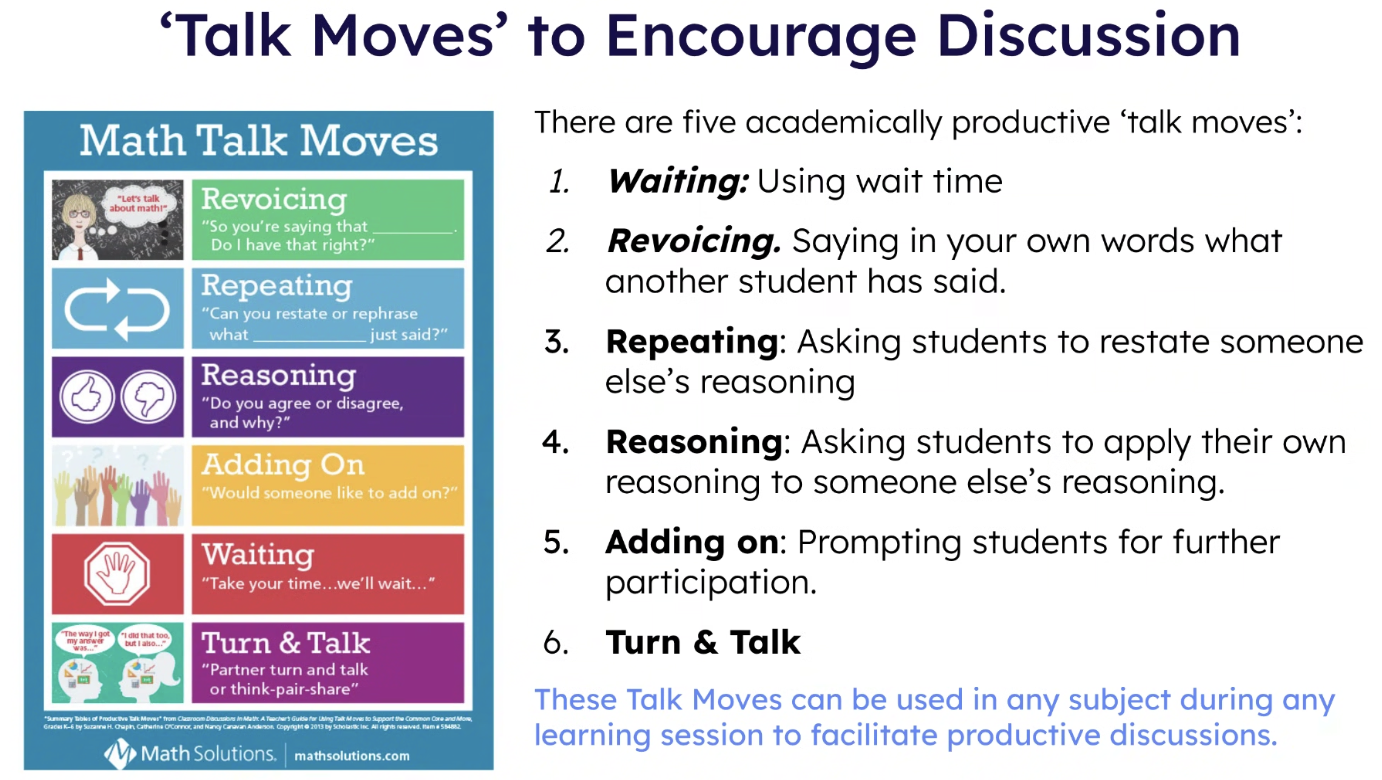

-Talk moves' was main focus in DMIC, raising social status

- Wait time is essential, a minute is a suitable time to wait.  Allow the students to 'think'.  Use the 'hand gesture' to say how they're feeling.

- construct 


To make connections for 'real-life' and maths, using these 'image talk' will help.  


Questions to ask:  Maths talks: What do you notice?  What do you wonder?  The next step is what 'maths can you see?'.

This is the feedback from staff during the workshop

Planning is essential even for 'image talk', what the learners might say. Be ready for the responses.

Our learners love sports, but still unable to see how it's connected for maths.

Logical and critically thinking.

Monday, 3 June 2024

2024 Teacher Only Day - Other workshops

The Manaiakalani Teacher Only Day workshops were fantastic! There were so many amazing options, but we could only pick two. I wish I could have attended a few more, as they were AI create workshops.

I'm hoping to find opportunities to use those creative teaching strategies in my classroom this term, or maybe next term.

In the meantime, I'd love to hear your ideas! What tools or resources have you found effective in helping students develop their creative skills?  Check out my few picks!


Thursday, 30 May 2024

Teacher Only Day - Bring Lessons to Life with AI Animations

This morning, my first workshop was led by Manaiakalani Facilitator and Project Lead Matt Goodwin,  titled "Bring Lessons to Life with AI Animations."

Matt used three AI tools: Lalamu Studio, Meta's AI Research, and Adobe Express (Animate from Audio). Here are a couple of things to consider when using these sites with our learners:

Ethical Consideration:  Consider using photos or animations of our learners' faces online. Since this information is kept on-site, it's important to remind our learners about being Cybersmart. 

Free tiers and limitations:  These free sites have limitations on usage.  They may offer credits/vouchers or renew free credit monthly. Upgrading to "premium" features typically comes with a cost.


Lalamu via Canva: Text to lip sync animation. It works directly from Canva and works best with text for lip syncing. I used this site to insert one of my student's stories and chose a female avatar to read her story.

    It's an awesome tool to use, for our learners to hear and proofread their work.  One of the downside of this free AI tool, it doesn't include reading with punctuation. 


Meta's AI Research: allows users to create animations, by drawing a character, uploading it on the site and select what movements you'd like your character to consider eg: running, walking, facial expressions etc.  


Adobe Express (Animate from Audio)  Allows users to record their voice, but using an animation.  Quite catchy for our learners to use this for their play recordings?


Will definitely give this a go for our learners to 'create' from their lessons.  

Monday, 16 October 2023

Teacher Professional Development: Create with AI

Today, Dorothy Burt was our guest speaker for our teacher professional development on "Creating with AI."

She highlighted the main ideas of engagement with learning, which should always include the learner's behavioral, cognitive, social, and emotional engagement.

Part of my Masters of Contemporary Education paper, I looked at 'what is student engagement?'  Axelson and Flick (2010) noted that etymologically speaking, "engage" means to formally agree to something. Bowden et al., (2019) view student engagement as the "glue" or  important contexts such as student's home lives, school, peers, and community to student success.

Axelson and Flick (2010) describes three forms of engagement: behavioural, emotional, and cognitive engagement. Behavioural engagement is described as outward cues.  Often the lines are blurred with student engagement, the belief of teachers' overall teacher judgement can be based on a learner's behavioural engagement or just not understanding or the learner is bored.

Cognitive engagement is about the student's will, how they feel about themselves, their work, their skills, and the strategies they utilize to master their work (Davis et al., 2012). Students within my class work hard, but still seem unable to learn effectively. Cognitive engagement refers to the quality of students' engagement, whereas pure effort refers to the quantity of their engagement in class.

As a classroom teacher, I agree with both authors as all four types of engagement need to be considered in planning teaching and learning tasks for students.

Dorothy continues to encourage us, to embrace these multiple AI websites.  I haven't used any of these AI art, however will use it to support our writing prompts.  


References:
Axel, R.D., & Flick, A. (2010).  Defining student engagement. Change: The magazine of higher learning, 43(1), 38-43.

Bolstad, R., Gilbert, J., McDowall, S., Bull, A., Boyd, S., & R Hipkins.  (2012).  Supporting future-oriented learning and teaching: A New Zealand perspective.  New Zealand Council for Educational Research.  Ministry of Education

Butler, D. L., & Cartier, S. C. (2004). Promoting effective task interpretation as an important work habit: A key to successful teaching and learning. Teachers college record, 106(9), 1729-1758.

Davis, H.A., Summers, J.J., & Miller, L.M. (2012).  What does it mean for students to be engaged?  An interpersonal approach to classroom management: Strategies for improving student engagement.  Corwin Press.  Pp 21-33.


Sunday, 13 November 2022

Manaiakalani Staff PD - Cybersmart

This afternoon, we had our Staff PD with Manaiakalani facilitator Fiona Grant reminding us of incorporating 'Being Cybersmart' ethos within our teaching practice.  Manaiakalani celebrates its 10 years + of implementing and growing 'CyberSmart' in a 'Learn, create, share' context.  Outstanding!

As our schools are evolving and interchanging with covid-19 disruptions and hybrid learning, still with 21st Century skills (critical thinking, collaboration, creativity, and communication) alongside 'cyber-smart' learning, this practice at an early stage in our learners education journey, will help develop and manage themselves as effective digital citizens. 

Manaiakalani have outlined 10 'smart' goals to assist our learners to manage or grow themselves in student engagement and agency.  Some of the Cybersmart learning such as 'Smart learners, smart media, smart relationships etc' can stand alone or integrate.

Within my class context, we have a tendency to  reinforce keeping a 'smart learner & smart footprint', as well as 'smart surfing'.  This prompt reminds the learner that they're using their google surfing for educational purposes/research, as well as locating appropriate authentic websites that will provide a genuine answers for their work.  Next it will inform all our learners that they're not invisible onsite and creating a classroom environment for 'smart learners'.  

Cybersmart online platforms

We have the few learners who deter away from staying focus on their work online.  A positive from 'cybersmart learning' is our learners watch out for each other, and gently prompt the other learners to be on the 'right place' site.

Most of our learners have been given choice to research topics of their own accord.  They've started to write/record sites that they've used to find their information.  This is reinforced that all information onsite must be 'attributed' or referenced for others to use the site.  

As of next year - will incorporate Cybersmart learning in my planning and take a look at other cybersmart ideas that will grow our learners not just in the classroom but in their own context.  

I wonder what the next 10 years will look like for our Cybersmart learners?


Sunday, 14 August 2022

Tohatoha Online Staff Meeting

Manaiakalani facilitated a 'Tohatoha' online Shared staff Meeting with approx 500 teachers across the country. Our group was facilitated by Christine (Team leader for Year 7&8 - Glen Taylor School), she shared her rich experiences used within her class and team and extended to one of our Teacher PD incorporating Culturally Responsive practice. It wasn't just 'ethnicity' teaching but 'student-led' learning.

Tuesday, 24 August 2021

Toolkits Online - Independent Learning - Contracts, Challenges and Stations

Key things to help me organise for independent learning:  

1. Established routines & rules:  Each child is an expert.  Each child needs to learn and practice.  3 before me.  Try and solve the problem without seeing me.

Contracts:  - the student plans and works out what their timetables look like.

- Compulsory tasks that student has to complete.  Deliberate planning to what needs to be done.  

Support students that struggle more - activities to buddy up.  Check-in with target groups regularly.- Meet with those students, go through all the tasks on the task.  I will check that they know what it's about.  The only group that is supported to timetable their work.  The planning is required prior to starting the contract. 

Monitoring:  Uses a data sheet.  Target inquiry group and follow through with learners who are reluctant to finish work.  Uses Hapara to filter websites that are appropriate to the task.   

Success criteria are established at the beginning of the class to ensure the learner will complete each task to a high quality.  The tasks have already been done.  Otherwise, the student can repeat the task again.

Each learner has the same contract.  Check that supports are there for struggling learners.  


Wednesday, 5 May 2021

Manaiakalani Teacher Professional Development Day

On the last day of term 1, the Manaiakalani cluster held their Ko te Kāhui Ako o Manaiakalani - Teacher Only Day. 

We had an appetizing smorgasbord of amazing workshops and pedagogies for us to choose from.  Our main speaker Dr Rae Si'ilata shared about Translanguaging and Literacies with our emerging bilingual learners.

She shared her experiences as a learner and a professional with challenges and ideas of how we can better engage our learners.  Using the Va'atele Model will guide us on how to better connect and have our learners succeed.

A couple of things struck a chord with me:
1. Finding more texts as windows than mirrors. 
2. Getting the 'talk' going in reading.  (Wonderful workshop from Robyn & Chantel Panmure Bridge School) .  
3.  The value of sharing our own stories, languages, and experiences that connect with the story or content in the book.
4.   Provide students with the opportunity to create using new media - collaborate, making choices in learning, creating and sharing.

Principles to keep in mind when planning:
* Prior knowledge plays an important role
* Comprehension depends on metacognition
* Reading and writing are integrally related
* Learning increases when students collaborate

It's helping me chip at my MIT challenge which is 'Supporting a high group of our Year 5 emerging bilingual students who are reading 2+ years below their reading age'.

By using Robyn Shearer's framework in developing more talk within the classroom.  For learners to work collaboratively together to create more 'mirror' texts that are 'authentic text.  Still thinking through my process .. lol!

Monday, 24 August 2020

PD Minecraft - EE Online Toolkit

An informative introductory workshop to the world of Minecraft. From this I can see, the benefits of Minecraft are endless, adopts our Manaiakalani ethos 'Learn, Create & Share'.

I've only used it once in our class space and that was to design a treehouse for a Panda. From that one session, students were heavily engaged in creating and discussing with other Minecraft experts on how to design this treehouse.

Ngā Motu Minecraft stood out for me.  For our students to engage and experience ao Maori.  There is one game where our players/learners to get learn the pronunciation.  This allows our students to have an opportunity to work things out.  A forum for our students to make mistakes and learn from them.

Below is my slide that I've copied from the original presentation. I can see benefits for our student's learning as well as computational thinking and develop their 21st Century skills. Predominantly our male students within our space are gamers, to teach critical thinking, collaboration, and communication. 

Hope we're able to get the Minecraft license.  I'll keep you guys posted!