Search This Blog

Showing posts with label 2020. Show all posts

Sunday, 16 March 2025

Toolkit: Maths Talks for Thinking & Discussion - Elena Terek

Today is my first toolkit for this term.  Please find the link to this workshop.

Elena presented the toolkit of "Maths talks as 'enablers' and extenders'. 

This year, my professional inquiry is looking at building vocabulary for our mathematical learners.  

Last week I was in a online workshop led by Dr Craig Hansen.  A couple of things struck a cord: 

1) creating engaging tasks will help our students build procedural fluency.  

2) Vocabulary is pivotal. 

Teaching literacy alongside math, checking that our students understand the key terms they need to succeed as they progress from Year 0 to Year 8.

At the end of each phase, there’s a vocabulary table that aligns with the year level, which helps us connect literacy with math and ensures our students have the foundational vocabulary for understanding. 

Rich task: high ceiling, low floor. 

Learning is a highly social activity.  Maths endorses this.  You can use 'image talk' to launch your maths talks.

Can can use multiple visuals, to support our learners to make connections.

A Survey's was conducted for Year 4-8, results from this survey, it was surprising to see that the students believed there is no connection with 'real-life' and mathematics. (interesting)

 How do we do this?

-create & maintain positive risk-free learning space

-ground rules for talk 

- provide opportunity to use different visuals or models.  Teacher will model mathematical thinking.
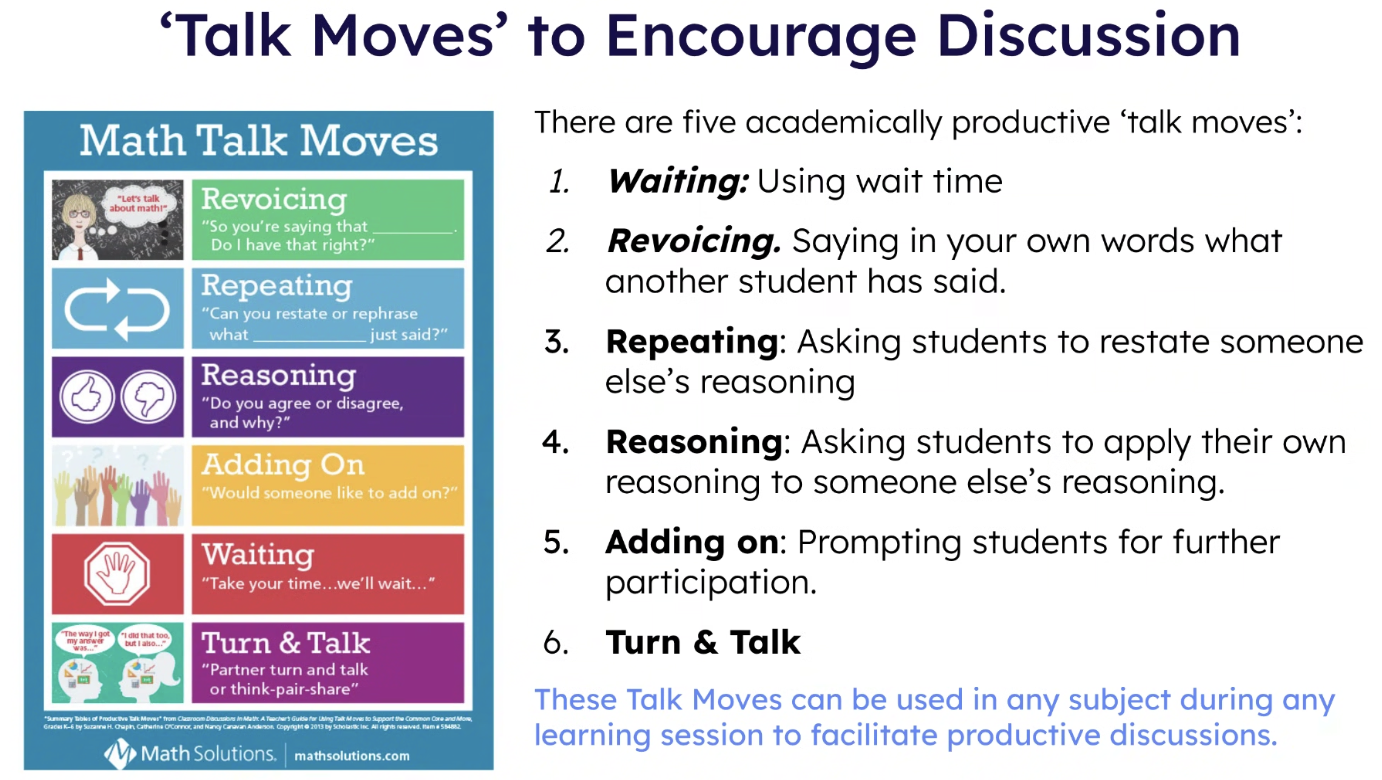

-Talk moves' was main focus in DMIC, raising social status

- Wait time is essential, a minute is a suitable time to wait.  Allow the students to 'think'.  Use the 'hand gesture' to say how they're feeling.

- construct 


To make connections for 'real-life' and maths, using these 'image talk' will help.  


Questions to ask:  Maths talks: What do you notice?  What do you wonder?  The next step is what 'maths can you see?'.

This is the feedback from staff during the workshop

Planning is essential even for 'image talk', what the learners might say. Be ready for the responses.

Our learners love sports, but still unable to see how it's connected for maths.

Logical and critically thinking.

Monday, 24 August 2020

PD Minecraft - EE Online Toolkit

An informative introductory workshop to the world of Minecraft. From this I can see, the benefits of Minecraft are endless, adopts our Manaiakalani ethos 'Learn, Create & Share'.

I've only used it once in our class space and that was to design a treehouse for a Panda. From that one session, students were heavily engaged in creating and discussing with other Minecraft experts on how to design this treehouse.

Ngā Motu Minecraft stood out for me.  For our students to engage and experience ao Maori.  There is one game where our players/learners to get learn the pronunciation.  This allows our students to have an opportunity to work things out.  A forum for our students to make mistakes and learn from them.

Below is my slide that I've copied from the original presentation. I can see benefits for our student's learning as well as computational thinking and develop their 21st Century skills. Predominantly our male students within our space are gamers, to teach critical thinking, collaboration, and communication. 

Hope we're able to get the Minecraft license.  I'll keep you guys posted!
 

Wednesday, 6 November 2019

Writing PD with Dr Jannie

 Crafted writing - apprenticed writing


Proof-reading/editing

Sentences


Editing - Does it make sense (at the word group by word group, sentence by sentence level) - Not left until the very end. Ongoing, continuous right from the start. Need to model this and expect this.


Detailing: Expanded word groups; construction of sentences (detailed simple sentences; complex sentences). What does a sentence with more detail look like?


Vocabulary: 


Spelling: ‘sounding out’ doesn’t work as so few English words actually can be sounded out.

  1. Starting a draft paper lesson. (sometimes)

  2. Build-in small little components of phonological training - mostly blends and suffix’s/prefixes. Start off with a small amount of time “5 minutes maybe”. - Think of the number of sounds associated with ‘ou’ - about 13!!. Start creating word-groups e.g. all words with a ou sound as in ‘rough’ - for each, get children to describe the word. If the children come up with a different word with the same sound, e.g stuff, start a new word group - park it though otherwise, you will confuse the kids.

  3. Dictation. Write the dictation by hand. Self-check. Sentence structure, sense, missing words, and spelling. Collate the mistakes and practice them as their “spelling words”


Knowing how the text works in quality texts

Noticing of the text to find the main ideas and why they are the main ideas


Great paragraph writers - we want this. Knowing that a paragraph and/or a long text are necessary - take it from this angle rather than the sentence angle (full stops/cap letters)


Topic (what am I writing about) /purpose (why am I writing about this)/ audience should be what we start with at the beginning of the year.

  • We do this automatically as adults, more than we realise.

  • We need to be more explicit at teaching this to our children

  • Need to be multi-model (able to use print, visual, static, moving, and spoken).

  • Need to be multi-generic (do a little bit of explaining, doesn’t need to be prose text, might have anecdotes, etc). - would be tricky to do this on our blogs


How can we push out the windows to writing for audiences other than just for our bloggers??


How do we make writing motivational for the kids?

  • Write a whole bunch of different writing styles around a central motivational topic - fits well with our inquiry topics.


Maximise understanding/minimise confusion is an author’s main purpose. 


Lots of mileage of the ideas to include


I have a role as a writer to put these ideas into paragraphs.


  1. Thinking

  2. Gathering ideas/knowledge - need to be able to do this BEFORE they even consider crafting a piece of writing.


Important to have a high level of motivation for the topic of writing - this is really important.


Get kids to know their topic - if they don’t, get them to think more and get more information about what they need to know. Organise it - which parts are you going to write about, sequential or are they going to hone in on one part? 


Read aloud


Children that get words wrong and have other people in their group jump in and say the word for them

  • Prepare the children. Give them practice time to go over what section you want them to read. If they still say it wrong, let the group have a go or let the child take ownership of their apprenticeship

  • Could even read part of the text first and then get children to repeat - repetition is known to be good for comprehension.


Every piece of writing: Topic, Purpose, Audience - Even free writing.

  • Topic: ?

  • Purpose: ?

  • Audience: ?